I led a UX enhancement initiative for the Oracle Cerner client app upgrade tool, focusing on the Go Live Console—a core component of the Cerner Advance platform in the Upgrade Center. Despite strict time constraints, I performed in-depth UX reviews, identified critical usability issues, prioritized solutions, and delivered actionable design recommendations. These efforts significantly improved the user experience for both healthcare clients and the internal team—product owners, developers, and analysts.
Project>
Upgrade Center, Go Live Console
Team & Role>
I led this UX project independently. For the Cognitive Walkthrough research, I partnered with a colleague, alternating roles as facilitator and user to ensure a thorough and unbiased evaluation.
Target User Groups>
- Upgrade Center engagement owners
- Upgrade Center engagement analysts
- Upgrade Center managers/directors
Objectives>
The Upgrade Center, Go Live Console project aimed to achieve several key objectives:
- Ensuring Stakeholders’ MVP Requirements:
- Deliver an enhanced solution with a limited scope within two weeks
- Improve core Go Live Console workflows and functionalities
- Providing UX Expert Review Documentations:
- Evaluate usability issues through UX expert reviews
- Propose design solutions to address identified issues
- Prioritize issues based on scalability and urgency
Tools & Technical Platforms>
Miro (visual collaboration platform), Microsoft Word
UX Process>
- Revealing Usability Problem Areas:
- Conducted UX expert review I – Heuristic Evaluation (user research method)
- Conducted UX expert review II – Cognitive Walkthrough (user research method)
- Prioritizing Next Steps:
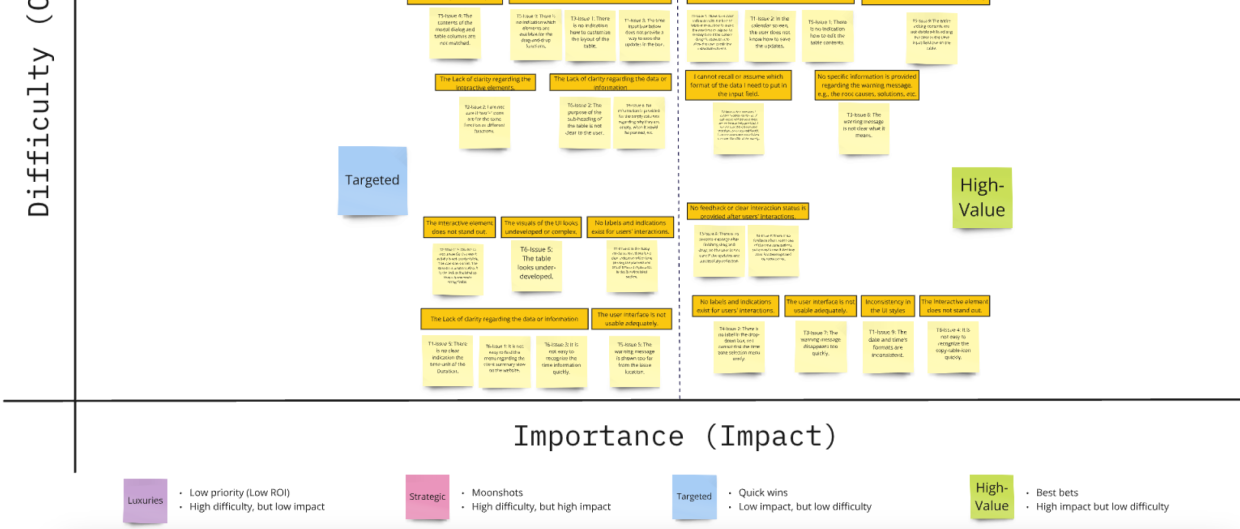
- Prioritized each issue based on difficulty and importance levels
- Created a four-category difficulty/importance matrix
- Proposing Actionable Design Solutions:
- Documented all issues with type and identifier in the UX evaluation
- Proposed design solutions for each identified issue
- Provided guidelines for mapping matrix data to corresponding design solutions by issue type and identifier
Challenge) Initial expectations for a two-week delivery on a complex project with entirely new workflows were challenging. The project’s complexity, combined with the need to quickly understand existing systems and navigate dense technical jargon while managing multiple projects, prevented the completion of the full UX process (discovery to high-fidelity prototyping) within the tight timeframe.
=> Resolutions:
Through ongoing, transparent communication with the product team, we established a shared understanding of the project’s constraints and priorities. We collaboratively shifted the deliverable scope from a high-fidelity interactive prototype to a comprehensive UX documentation package—including UX expert reviews and detailed design recommendations for all identified issues. This strategic pivot ensured the team received immediate, actionable guidance, mitigated project risks, and delivered substantial value within the original timeline and resource limitations.
Lessons Learned:
I learned that establishing a shared understanding is essential when there is a gap in expectations between the UX and product teams. One-on-one communication was invaluable for clarifying the product team’s goals and expectations, as well as for communicating the realistic project scope I could deliver within the timeline.
The product team provided feedback that the comprehensive UX review documents were helpful, enabling them to efficiently address key usability issues and access clear, actionable design solutions at a glance. They were especially impressed by the difficulty/importance matrix, which served as an impactful tool for prioritizing next steps and focusing improvements based on urgency and scalability.